
FILTRATION, ELECTROLYSIS & THERMAL APPLICATIONS
Porous Ceramic Products
Ceramic membranes and components for concentration, filtration, electrolysis, and dewatering, alongside thermal insulation and reflector boards for food-packaging equipment. Explore each product’s applications, material characteristics, and specifications.
Rotating Ceramic Membranes
Product Features
Rotating ceramic membranes support stable, continuous filtration, with a gradual decline in membrane flux and limited sensitivity to changes in feed concentration. They are well suited to filtering and concentrating high-concentration, high-solids feeds, with achievable solids contents above 90%. Filtration on both sides increases the effective filtration area within the same volume, improving efficiency while maintaining stable operation and simplifying cleaning.
Applications
Biopharmaceuticals, food and beverages, energy and petrochemicals, and wastewater treatment.
Technical Specifications
| Parameter | Value |
|---|---|
| Maximum dimensions (mm) | Ø374 × 6 mm |
| Filtration rating | 100 nm, 200 nm, and other ratings; custom options available |
| Al₂O₃ content (%) | ≥99% |
| Maximum rotational speed (rpm) | ≥650 rpm |
| Flatness (mm) | ≤0.2 mm |
| Support flexural strength (MPa) | ≥55 MPa |
Ceramic Electrolysis Cells
Product Features
Also used as ceramic diaphragms and ceramic cylinders in electroplating systems, these components are made primarily from high-purity alumina and sintered at high temperatures. They combine acid and alkali resistance, high porosity, an appropriate pore size for the application, and good mechanical strength.
Applications
Regeneration of etching baths used in electroplating plastics and removal of impurities from chromium plating baths.
Technical Specifications
| Parameter | Value |
|---|---|
| Porosity (%) | ≥40% |
| Pore size (μm) | 0.5–2 μm |
| Flexural strength (MPa) | ≥25 MPa |
| Acid resistance (%) | ≥99% |
| Alkali resistance (%) | ≥94% |
Ceramic Membrane Tubes for Electrolysis
Product Features
Designed for sodium chloride electrolysis, these ceramic membrane tubes have carefully controlled ceramic wall density and pore size. They separate the anode and cathode compartments while allowing ions to pass through the membrane during the production of hypochlorous acid and sodium hydroxide.
Applications
Chemical processing.
Technical Specifications
| Parameter | Value |
|---|---|
| Pore size (μm) | 0.1 μm; 0.3 μm |
| Apparent porosity (%) | ≥45% |
| Acid resistance (%) | ≥99% |
| Alkali resistance (%) | ≥98% |
Ceramic Diaphragm Plates for Electrolysis
Product Features
Used in diaphragm electrolysis to synthesize chemical products, these thin ceramic plates offer good strength and resistance to acid and alkali corrosion.
Applications
Chemical processing.
Technical Specifications
| Parameter | Value |
|---|---|
| Porosity (%) | ≥35% |
| Pore size (μm) | 1–3 μm |
| Flexural strength (MPa) | ≥15 MPa |
| Acid resistance (%) | ≥95% |
| Alkali resistance (%) | ≥90% |
Ceramic Filter Plates
Product Features
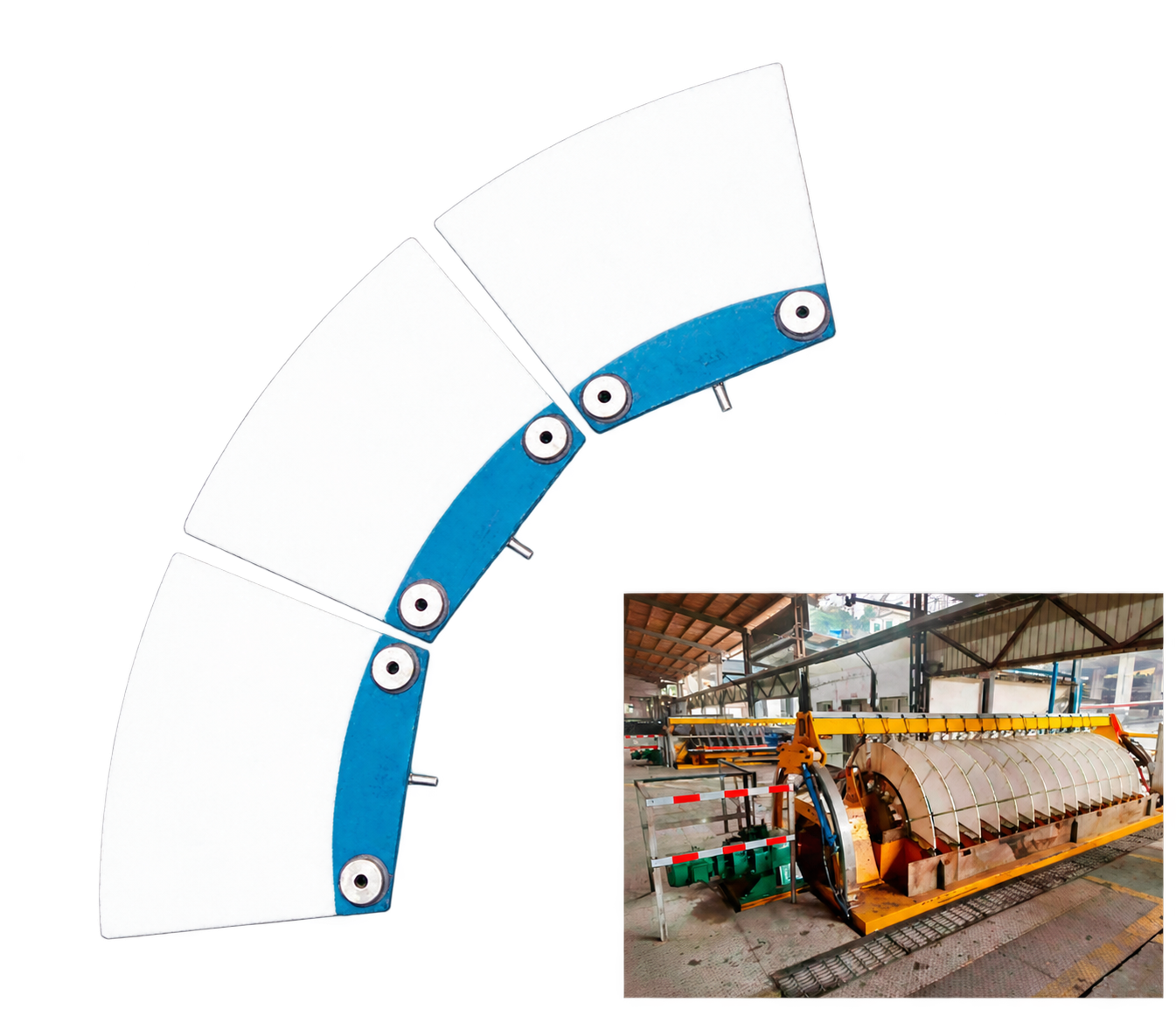
Ceramic filter plates provide dewatering and filtration for nonferrous metal mining, fine-coal processing, chemicals, food, pharmaceuticals, and ceramics. They handle particles ranging from 0.5 μm to 3 mm and are particularly well suited to dewatering and solid–liquid separation of sand-containing materials.
Applications
Mining.
Technical Specifications
| Parameter | Value |
|---|---|
| Apparent porosity (%) | ≥35% |
| Pore size (μm) | 1–3 μm; custom options available |
| Flexural strength (MPa) | ≥25 MPa |
| Filter cake moisture (%) | 7–12% |
Thermal Insulation & Reflector Boards
Product Features
Made primarily from corundum and fired at high temperatures, these high-strength boards provide thermal insulation and heat transfer in bottle blow-molding equipment. They do not release substances harmful to health during use and offer energy-saving and environmental benefits.
Applications
Food packaging.
PERFORMANCE BY APPLICATION
Why use porous ceramics?
Porous ceramics serve filtration, dewatering, and electrochemical applications. Selection depends on the pore structure, process chemistry, and operating conditions—not porosity alone.
Manage buildup in concentrated feeds
In dynamic filtration systems, rotating membranes help limit surface buildup when processing concentrated feeds. The benefit depends on the feed properties and the design and operation of the filtration system.
Match process and cleaning conditions
Ceramic membranes can tolerate demanding chemical and cleaning conditions. Compatibility must be checked against the ceramic composition, chemical concentration, and temperature rather than assumed for every acid or alkali.
Match the separation target
Membrane pore size must suit the particles or substances to be separated. Ceramic membranes are available for different filtration duties; the required retention and throughput should be evaluated with the actual feed.
Control moisture in the filter cake
Ceramic filter media retain solids while allowing liquid to pass. Achievable cake moisture and filtration rate depend on particle size, feed chemistry, and operating conditions.