
CERAMICS FOR INDUSTRIAL APPLICATIONS
Ceramics for Other Industries
From alloy melting and wear-resistant machinery components to high-voltage insulation, explore zirconia, silicon nitride, and large ceramic products for demanding industrial applications.
Magnesia-Stabilized Zirconia Crucibles
Product Features
Manufactured from fused magnesia-stabilized zirconia by high-temperature sintering and heat treatment, these crucibles offer high material purity, chemical stability at high temperatures, and thermal shock resistance.
Applications
Melting high-temperature nickel-based alloys for investment casting.
Technical Specifications
| Parameter | Value |
|---|---|
| ZrO₂ content (%) | >95% |
| Porosity (%) | <19% |
| Bulk density (g/cm³) | 4.4–4.7 g/cm³ |
| Coefficient of thermal expansion (10⁻⁶/°C) | 7.2 × 10⁻⁶/°C at 1,000 °C |
| Flexural strength (MPa) | >35 MPa |
Magnesia-Stabilized Zirconia Components
Product Features
Made from ultrafine magnesia-stabilized zirconia powder by high-temperature sintering and heat treatment, these partially stabilized zirconia components combine thermal shock resistance, high strength, wear resistance, and toughness.
Applications
Wear- and heat-resistant components for steelmaking equipment; ceramic valve cores for specialized pump and valve equipment requiring wear, heat, and corrosion resistance; metal wire-drawing guide wheels; and kiln components.
Technical Specifications
| Parameter | Value |
|---|---|
| ZrO₂ content (%) | >95% |
| Bulk density (g/cm³) | ≥5.7 g/cm³ |
| Three-point flexural strength (MPa) | ≥500 MPa |
| Elastic modulus (GPa) | 250 GPa |
| Vickers hardness (HV0.5) | 1,100 HV0.5 |
| Coefficient of thermal expansion (10⁻⁶/K) | 10 × 10⁻⁶/K |
| Thermal shock resistance, water cooling, ΔT (°C) | 450 °C |
| Maximum operating temperature (°C) | 2,100 °C |
Yttria-Stabilized Zirconia Components
Product Features
Made from ultrafine yttria-stabilized zirconia powder by high-temperature sintering, these partially stabilized zirconia components offer high room-temperature strength, wear and corrosion resistance, and toughness.
Applications
Ceramic bearings, pump and valve components, cylinder sleeves, and other parts for petroleum, chemical processing, food, textiles, pharmaceuticals, and related applications.
Technical Specifications
| Parameter | Value |
|---|---|
| ZrO₂ content (%) | >96% |
| Bulk density (g/cm³) | ≥6.05 g/cm³ |
| Three-point flexural strength (MPa) | ≥800 MPa |
| Fracture toughness (MPa·m½) | >9 MPa·m½ |
| Elastic modulus (GPa) | 220 GPa |
Silicon Nitride Products
Product Features
Sintered from ultrafine silicon nitride powder at high temperatures in a nitrogen atmosphere, these ceramics offer high-temperature resistance, corrosion and wear resistance, high toughness, and high flexural strength. They are suited to demanding operating environments where conventional metals and other materials may not meet application requirements.
Applications
Bearings for industrial machinery, liners and grinding media for ultrafine grinding equipment, and pipe liners.
Technical Specifications
| Parameter | Value |
|---|---|
| Si₃N₄ content (%) | ≥87.5% |
| Bulk density (g/cm³) | ≥3.2 g/cm³ |
| Water absorption (%) | 0% |
| Apparent porosity (%) | <1% |
| Rockwell hardness (HRA) | ≥91 HRA |
| Vickers hardness (GPa) | >15 GPa |
| Flexural strength (MPa) | ≥500 MPa |
| Fracture toughness (MPa·m½) | >6 MPa·m½ |
| Volume resistivity (Ω·cm) | 2.9 × 10¹³ Ω·cm |
| Wear volume loss (cm³) | <0.5 cm³ |
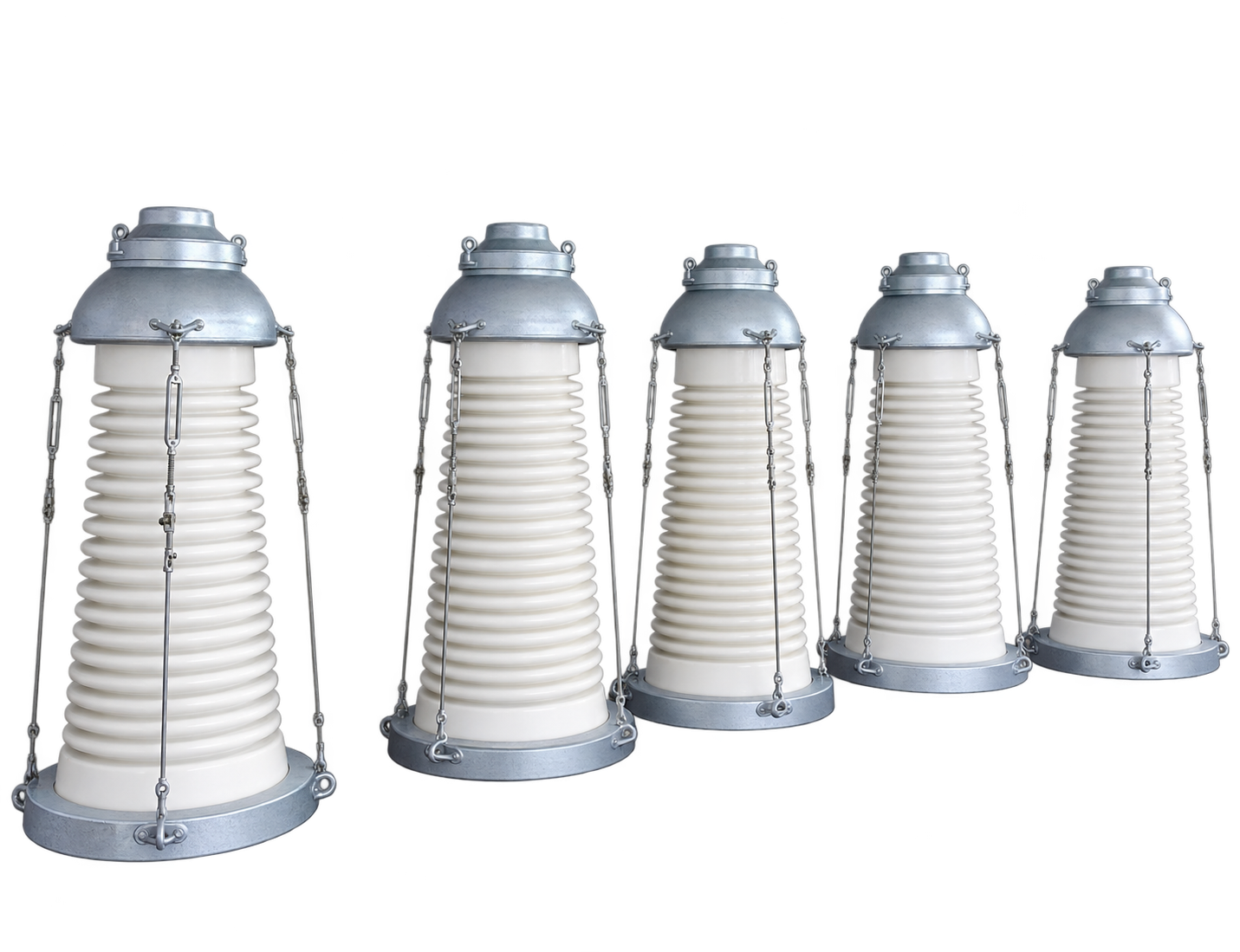
Large Ceramic Insulators
Product Features
Formed from a specially formulated 95-grade ceramic powder and fired at high temperatures, these insulators have a maximum outer diameter of 635 mm, a maximum height of 1,600 mm, and wall thicknesses of 100–250 mm. They provide high compressive load capacity at room temperature and good dielectric properties.
Applications
Base insulators for medium-wave radio transmitting antennas.
Technical Specifications
| Parameter | Value |
|---|---|
| Maximum outer diameter (mm) | 635 mm |
| Height (mm) | 1,600 mm |
| Bulk density (g/cm³) | ≥3.7 g/cm³ |
| Nominal voltage (kV) | 120 kV |
| Operating frequency range (kHz) | f1–f2 kHz |
| Nominal creepage distance (mm) | ≥3,000 mm |
| Power-frequency dry withstand voltage (kV) | 300 kV |
| Power-frequency wet withstand voltage (kV) | 260 kV |
| Lightning impulse withstand voltage (kV) | 650 kV |
| Dielectric loss factor at 50 Hz and nominal voltage | ≤0.002 (dimensionless) |
| Temperature rise at power frequency / operating frequency (°C) | <90 °C |
| Minimum compressive load capacity (kN) | ≥10,500 kN |
| Minimum lateral shear load capacity (kN) | 100 kN |
MATERIALS MATCHED TO THE APPLICATION
Why use technical ceramics?
Industrial ceramic components address different combinations of wear, heat, chemical exposure, and electrical loads. Select the ceramic composition for the service conditions rather than assuming one material suits every application.
Match the crucible to the melt
Crucibles must withstand the melting temperature and remain compatible with the alloy. Refractory selection should account for chemical interaction and the heating and cooling cycle.
Resist abrasive service conditions
Stabilized zirconia combines hardness and fracture toughness for demanding wear applications. It is used in components such as bearings and valve parts, with the grade selected for the load and process medium.
Handle heat and mechanical stress
Silicon nitride combines mechanical strength with thermal shock resistance. These properties are useful for components exposed to mechanical loads and temperature changes.
Support loads while providing insulation
Antenna base insulators must provide electrical isolation while carrying structural loads. Ceramic insulator selection must address both the electrical requirements and the mechanical loading.